Contents
- Why a weekly reset matters
- Gather your tools
- Review the previous week
- Carry forward unfinished tasks
- Set priorities for the new week
- Fill in your weekly planner
- Add habit and reflection notes
- Keep it flexible and simple
It’s Sunday evening, the kitchen light is soft, and you’re sipping tea while a stack of loose notes and half‑finished to‑do lists sits on the table. You glance at the calendar, notice a few tasks still unchecked, and feel a vague sense of mental clutter that makes the quiet feel noisy.
A weekly planning reset can turn that feeling into a clear start, without demanding a big overhaul. By taking a few minutes to reflect on what happened, move unfinished items forward, and choose the top priorities for the days ahead, you create a simple roadmap that eases the mind.
In this guide we walk through each step – reviewing the past week, deciding what truly needs to move on, setting three realistic goals, and noting a quick gratitude point to keep the tone light. The process works with any paper planner you already have, so you can start right away. You’ll finish the session feeling a little lighter, ready to greet Monday with a sense of direction rather than dread.
Why a weekly reset matters
Starting each week with a brief reset gives your mind a chance to clear out the clutter that builds up after days of juggling tasks. When you pause to note what worked, what didn’t, and what you truly want to achieve, you create a mental space that makes new decisions feel less heavy. A short planning session on Sunday evening often reduces the number of tasks that slip through the cracks and eases the mental replay of unfinished work.
Research that looked at employees who added a weekly planning habit found that they left fewer tasks unfinished and reported less rumination after work. The same study noted a boost in weekly mental flexibility – simply put, people felt more able to adapt when unexpected things came up.
Beyond the numbers, the everyday benefit is clear: you start the week with a sense of direction rather than a vague to‑do list. A simple approach is to spend ten minutes writing down three core goals for the week, then jot a quick note about any potential obstacles (like a busy Thursday meeting). This tiny step turns a chaotic inbox into a focused roadmap.
- Reduces the mental load of remembering unfinished items.
- Creates a natural pause that separates past work from upcoming priorities.
- Improves your ability to shift plans when surprises arise.
When you make the reset a regular habit, the process becomes almost automatic, and the mental clutter that once lingered throughout the week starts to fade away.
Gather your tools
Before you begin the weekly reset, pause to gather the few items that keep the process smooth. Having everything in one place eliminates the need to search for a pen or a page, preserving the calm you want to create. A simple, dedicated notebook or an undated weekly planner, a reliable pen, and a small stack of sticky notes are usually enough to capture ideas, priorities, and reminders.
Here is a quick checklist of tools you might gather:
- A notebook, planner, or a few loose sheets reserved solely for the weekly reset.
- A pen or pencil that writes comfortably.
- Sticky notes or small index cards for quick brain‑dump ideas.
- A timer or phone alarm to set short blocks for each step.
- A quiet spot – a kitchen table, a couch corner, or a desk – where you can work without interruptions.
Once the items are ready, you can move straight into the reset. On a Sunday evening you might sit at the kitchen table, open your notebook to a fresh page, and spend five minutes writing down anything still on your mind. Then place a sticky note on the page to highlight the three most important tasks you want to finish next week. This brief routine clears mental clutter before you start filling in the weekly planner.
Keeping these tools handy each week turns the reset into a habit rather than a chore. It also makes reviewing your plan later easier, because everything you wrote stays organised in the same place.
Review the previous week
Taking a few minutes to look back on the past seven days helps you see where your time and attention really went. Naming what was finished, what slipped, and why can clear the mental clutter that otherwise follows you into the new week. It also gives you a chance to celebrate small wins, which can boost confidence without any hype.
Open a fresh page in your notebook or a simple digital note. Write down three categories:
- Completed tasks – list the things you crossed off, even the tiny ones like sending a quick email.
- Unfinished items – note anything that stayed on your list, and add a brief reason (e.g., “postponed because of back‑to‑back meetings”).
- Highlights – record a moment that felt good, such as finishing a report early or having a calm coffee break.
You might write: “Tuesday – finished client report; Thursday – missed grocery run because two meetings ran over. Next time, block a 15‑minute buffer after the second meeting.” Reflecting in this way often reveals patterns, like recurring over‑booking or tasks that consistently get pushed aside. Once you see the pattern, you can adjust next week’s plan – perhaps by moving a low‑energy task to a day when you feel more refreshed.
End the review with a quick gratitude note – a sentence about something you appreciated this week. That tiny act can shift your mindset from “what’s left undone?” to “what went well?”, setting a calmer tone for the planning ahead.
Carry forward unfinished tasks
After completing your weekly review, you’ll notice some tasks that remain unfinished. Instead of leaving them in an undefined “to‑do” list, assign each one a specific place in the upcoming week. Ask yourself whether the task still matters and when it could realistically be completed. If it does, schedule it for a particular day and time, just like any new item.
Consider this scenario: you began drafting a client proposal on Monday but ran out of time. On your reset day, write “Finish client proposal draft” in Thursday morning’s block and note any needed resources—perhaps a quick call with a colleague. By giving the task a concrete slot, it becomes part of your plan rather than a lingering thought.
Here are three quick steps to carry forward unfinished work:
- Identify the task and decide if it still aligns with your weekly goals.
- Choose a realistic day and time slot, considering your energy levels.
- Note any prerequisites (files, contacts, information) next to the task.
Moving unfinished items into a defined slot often reduces mental clutter and the impulse to keep revisiting the mental list. It also reveals your true capacity, since the slot occupies real time in your schedule. When a task no longer feels relevant, you can simply release it—your weekly reset provides an opportunity to tidy both completed and incomplete work.
Set priorities for the new week
Choosing a handful of clear priorities at the start of the week, as part of a flexible planning system, helps the mind focus on what truly matters, rather than juggling a long, vague to‑do list. Identifying the top tasks early often makes the rest of the week feel less crowded and more purposeful.
Begin with the goals you set during your review and ask: which three to five items will move those goals forward the most? Write each priority as a short statement that includes the “what” and a brief “why”. A useful phrasing might be, “Prepare client presentation for Wednesday – it secures the new contract.” This small extra detail reminds you why the task matters and helps maintain motivation.
Once you have your priorities, arrange them in order of impact:
- Identify the single most important task (your “top priority”) and schedule a dedicated time block for it.
- Group related tasks together so you can work in a flow state.
- Leave a small buffer each day for unexpected items, keeping the core priorities untouched.
For instance, you might decide that Monday morning is for the client presentation, Tuesday afternoon for updating the project budget, and Thursday morning for a brief team check‑in. By anchoring each day with a priority, you reduce decision fatigue and keep mental clutter at bay.
Fill in your weekly planner
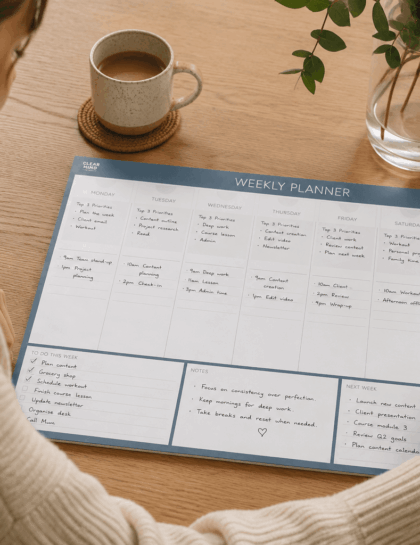
Putting the week onto a single weekly planner lets you view the entire schedule at once. A spacious, flat layout often lessens the habit of flipping pages and makes it simpler to notice gaps or overloads before the week starts.
Begin with the week’s dates across the top row. Underneath, list three to five key priorities—tasks that support your longer‑term goals and set the week’s direction. Then, fill the daily columns, assigning time blocks to each priority. Choose broad slots such as 9‑11 am or 2‑3 pm instead of precise minutes; this provides flexibility while maintaining structure.
- Mark any appointments or fixed commitments first, so you know the non‑negotiable slots.
- Place your priority tasks into the remaining open blocks, grouping similar activities together when possible.
- Leave a small “buffer” box each day for unexpected items or short breaks.
- Write a brief note beside each block about potential obstacles and a quick backup plan (e.g., “if the client call runs late, shift report writing to the afternoon”).
Finally, step back and scan the page. If a day looks too crowded, shift a task to another day or turn it into a smaller sub‑task. For instance, on Tuesday you might write, “Top task – finish draft of project brief (9‑11 am).” Then add a note, “If research material isn’t ready, use the 11‑12 am slot for a quick outline instead.” This visual check helps keep the week realistic and reduces mental clutter before you start.
Add habit and reflection notes
When you finish the core of your weekly plan, a quick habit and reflection check can keep the week feeling light. A tiny cue – like a short note about a daily habit – can remind you to act without thinking twice. A reflection line at the end of the week helps you notice what worked, what felt heavy, and where a small tweak could make next week smoother. This extra step is not about adding more work; it is about giving your brain a gentle reminder and a moment to close the loop.
Pick one habit you’d like to weave into the week. Write it in the margin of your planner or on a sticky note with a simple trigger, such as “9 am – water bottle on desk”. Then add a brief reflection prompt for the end of each day or the week, like “What was the best moment today?” or “Did anything repeatedly stall me?”. When you glance at these notes, the habit cue nudges you forward and the reflection question gives you a quick mental sweep, reducing lingering thoughts.
Here’s a simple way to apply it:
- Write “Morning stretch – 7 am” on the top left of your weekly page.
- At the bottom of each day, add a line: “One thing I enjoyed today”.
- On Sunday evening, answer: “What small change could improve next week?”
These brief entries take less than a minute but create a habit loop and a regular pause for insight. After a few weeks, you may notice patterns – perhaps a particular time of day is best for focused work, or a certain distraction keeps resurfacing. By recording these observations, you give yourself a clear, low‑effort way to fine‑tune future weeks.
Keep it flexible and simple
When a weekly plan feels like a strict contract, it can add pressure instead of clearing mental clutter. A little wiggle room turns the plan into a helpful guide rather than a set of rules. Treat each day as a collection of focus blocks, a core idea in planning your week without time blocking, instead of fixed hour‑by‑hour appointments. This approach lets you move tasks around when something unexpected arises and reduces the urge to abandon the whole plan because a single item slips.
For example, write a simple block for the morning such as “2‑hour focus on report draft, with a 30‑minute spill‑over if needed.” If a meeting runs late, shift the spill‑over into the afternoon without feeling you’ve broken the plan. A quick micro‑example: before bed, jot down tomorrow’s top three tasks on a sticky note – “reply to client email, finish chapter outline, 10‑minute walk.” When the day starts, place the note on your desk and treat each item as a flexible block; if the email takes longer, slide the walk later and still keep the overall rhythm.
Here are three easy ways to keep flexibility built into your weekly reset:
- Limit core tasks to three per day – anything beyond that can stay in a “later” column.
- Add a 15‑minute buffer after each focus block to handle overruns or short breaks.
- Keep a “move‑it” note where you can quickly shift a task to another day without re‑writing the whole plan.
Allowing small adjustments keeps your weekly plan useful and low‑stress, helping you maintain clarity without feeling trapped by a rigid schedule.
Key takeaways
- Schedule a 15‑minute weekly reset at the same time each week.
- Write down three to five priority tasks for the coming week and assign them to specific days.
- Move unfinished tasks to a new slot, noting the exact time and resources needed.
- Add sticky‑note habit cues (e.g., water break, stretch) directly onto your planner.
- End the week with a short reflection note on what worked and what didn’t.
- Leave 30‑45 minute buffer blocks each day for unexpected tasks or adjustments.
FAQ
How often should I do a weekly planning reset?
Most people find that doing a reset at the same time each week works well – typically on Sunday evening or Monday morning. This regular rhythm helps clear lingering thoughts before new tasks pile up, and it creates a predictable cue for your brain to shift into planning mode. If your schedule varies, choose a quiet moment when you can step back for 15‑20 minutes and make it a habit, even if the day changes.
What is the best way to handle unfinished tasks during a weekly reset?
First, list any tasks that didn’t get finished last week. Then decide if each one is still needed. For the ones you keep, assign a specific day, time, and any resources you’ll need – write it directly onto your planner or a sticky note. If a task no longer matters, cross it off. This simple step turns vague leftovers into clear, actionable items and prevents mental clutter from lingering.
How can I keep my weekly plan flexible without feeling disorganised?
Build small buffer blocks into each day – 15‑30 minutes of open time that can absorb unexpected tasks or shifts. Use colour‑coded or simple symbols to mark “must‑do” items versus “nice‑to‑have” ones. When something changes, move the flexible block rather than reshuffling the whole schedule. Over time you’ll notice the plan stays organised while still giving you room to adapt.
Conclusion
Finishing a weekly planning reset can leave you with a sense of mental lightness, as if a small weight has been lifted. By taking a few minutes to review, carry forward, and set clear priorities, you give yourself space to focus on what truly matters.
When you treat this reset as a gentle, regular habit rather than a one‑off task, it becomes a quiet anchor that helps you stay adaptable and calm throughout the week. You may notice that each new Monday feels a little easier, and that feeling can carry you forward with confidence.
If you’d like a simple, spacious place to capture your weekly reset, the A3 Weekly Desk Pad Planner can be a gentle tool to keep your plans visible and your mind clear.